
More than one hundred years after her death, Janet Stuart’s writings on education still inspire Sacred Heart Educators with their timeless wisdom, breadth of outlook and eye towards the future.
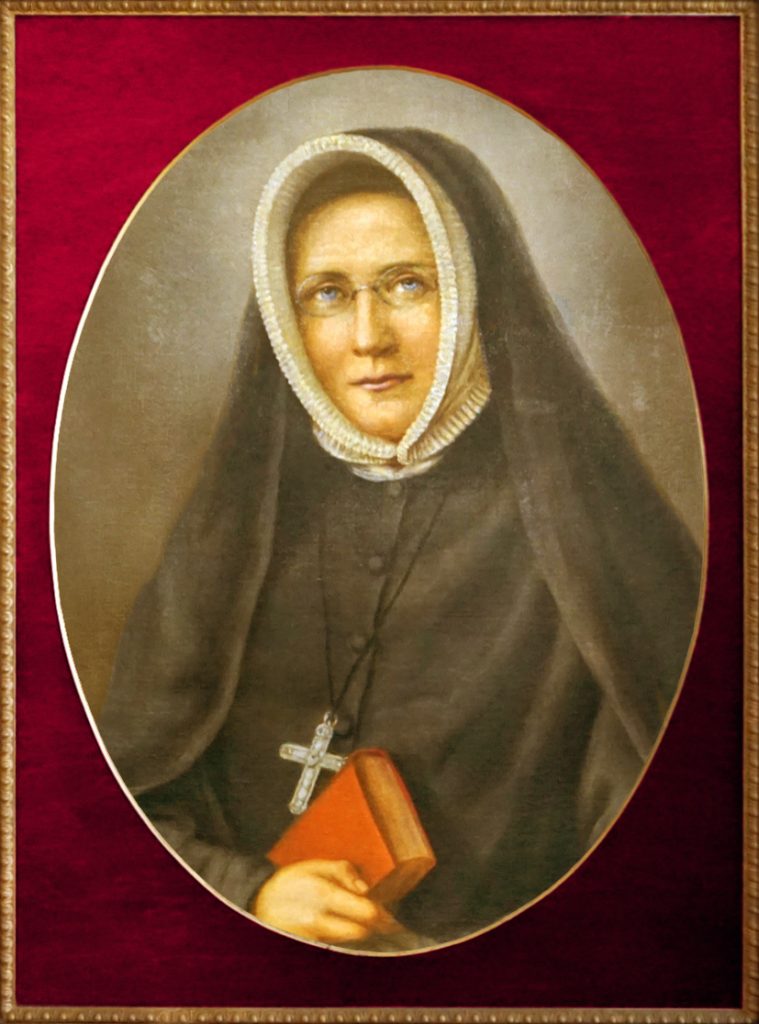
Janet was born in 1857 in Cottesmore, Rutland, England as the youngest of the thirteen children of the Anglican Rector, Reverend Andrew Stuart. Intellectually gifted, she was educated at home where her studies included philosophy, maths and literature as well as German and French in both of which she became fluent. Janet accompanied her father on his visits around the Parish which gave her an appreciation of nature and a knowledge of agriculture. The area around Cottesmore was renowned for the Hunt. Janet joined in, loved it, and became a daring horsewoman.
A remark from her brother telling her that Aristotle said all creatures had a “last end”, or ultimate purpose, set Janet off on a personal search. This search led her through a time of religious scepticism, interest in continental philosophy and eventually to the Jesuits at Farm Street where she was received into the Catholic Church. This decision meant that Janet had to leave home, as living in the Rectory after taking such a step would have caused great scandal. Janet lived with friends and relatives in London and Ireland until her future became clear to her. She entered the Society of the Sacred Heart at Roehampton in 1882, the same year as the foundation at our own Kincoppal-Rose Bay, Sydney.
Janet’s gifts were soon recognized in the Society and over the years she was appointed Mistress of Novices, Superior of Roehampton and then Superior Vicar, a role similar to the Provincial today. Janet was valued as a wise spiritual guide and wholistic education was her passion. She gave many conferences to the Sisters on the subject and gathered the essence of her thoughts in her book “The Education of Catholic Girls”. Sacred Heart Educators still value this book as a source of inspiration, and it is appreciated by many other educators.
In 1911, Janet was elected Superior General of the Society and for the next three years she set off on a world tour to visit all houses of the Society to give her an understanding of their various cultures. Her journeys ended at the same time as the outbreak of the First World War. She had a dramatic escape from Brussels to Roehampton in England where she could maintain contact with the rest of the Society. Janet was ill when she arrived and never recovered.
Janet died in 1914 and was buried in the Sacred Heart Chapel in Roehampton.
We have been left with a rich legacy of Janet’s writings and her personal example. She urged us to “Think glorious thoughts of God and serve him with a quiet mind.” Janet also reminds us in this age of change that “We bring up the children for the future, not for the present, not that we may enjoy the fruit of our work, but for others.”