
Pope Francis said, “We are not living an era of change but a change of era.” In these times, our Saint Rose Philippine Duchesne, (Philippine), missionary to the New World, is an ideal role model for all the communities gathered under the care of Sophia.
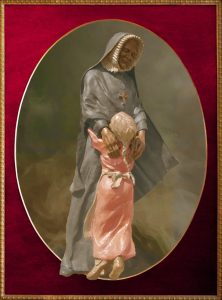
Philippine was born in Grenoble, France, in 1769, into the Perier – Duchesne family who had political and financial interests. She was educated at home with her siblings and cousins and was prepared for her First Communion at the Visitation Convent, Sainte Marie d’en Haut. In 1788, against her family’s wishes, Philippine joined the Visitation Order at Sainte Marie.
The outbreak of the French Revolution saw the Visitation community dispersed and in 1792 Philippine had to return home. During the following nine years Philippine spent time visiting prisons and gathering children to teach them catechism. Eventually, with the help of family influence, Philippine was able to purchase Sainte Marie and she tried to re-establish the Visitation Community there. Her efforts were unsuccessful, and she was introduced to Sophie Barat who agreed to accept Philippine and her convent into her newly founded order.
Philippine made Vows in the new Society and filled various roles while constantly reminding Sophie of her desire to go as a missionary to the native Indians of America. At the age of forty-eight, in 1818, Philippine set sail for the New World on the ‘Rebecca’ with five companions. The voyage was almost life-threatening and, on arrival, Philippine found that she was not to go to the Indians, as she had hoped, but to the frontier, west of the Mississippi.
Settling first in St Charles, Philippine and her companions set up a free school and a boarding academy. The following year they moved to Florissant where the first noviceship was established. Gradually, young women joined the Society, and more schools were opened in other parts of the country. Philippine never learned English well, so she did much of the hard manual work as well as the administrative work as Superior. On several occasions, she had asked Sophie to release her from this latter role as she did not think she was suited for it. During this time, she still cherished a desire to go to be with the Indians.
In 1841 a Jesuit invited the Society to send a group of Sisters to the Indian mission among the Potawatomi at Sugar Creek. Now seventy-two, Philippine was finally able to fulfil her lifelong desire and live in an Indian settlement. Life was very hard there, and Philippine spent long hours in prayer, so the Indians gave her the name “Kwah-kah-kum-ad,” the “Woman Who Prays Always”.
At the end of a year, Philippine’s ill health necessitated her return to St Charles where she lived for another ten years until she died in 1852.
Philippine lived up to her family name, Duchesne, “of the oak”. Her strong friendship and loyalty to Sophie meant that she forged the initial bonds that developed into our international network. She models for us the courage and perseverance it takes to cross boundaries and hold to a dream, a dream that took her almost a lifetime to fulfil, and was not realised in the way she had originally envisioned.
In 1988 Philippine was Canonised with the support of the Archdiocese of St Louis.